


What is a buying committee in B2B sales?

The deal that died in “maybe”
The deal should have closed weeks ago.
Barry, enterprise AE, has done everything right.
He’s walking around the office like, “I nailed this. Done. Dusted. Put it on the board.”
The champion loved the product. The demo? Oh, forget it, people were nodding, laughing, taking notes like it was a TED Talk. Legal barely touched the redlines, just changed a comma so they could feel important. Forecast said “commit.” Barry’s already mentally spending the commission, looking at holiday villas like, “Yeah, I deserve this.”
Then… the email.
“We had an internal meeting and decided to pause. There are still a few concerns from ‘the team’ we need to sort out first.”
“The team?”
Now Barry’s staring at his screen like, “Who is this team? Is this The Avengers? Did I miss a meeting?”
Over the next two weeks, he finds out “the team” means:
- A Head of IT who looks at every integration like, “Why you makin’ me work even more?”
- A Security lead with a checklist so long it needs its own Gantt chart.
- A Finance controller who doesn’t see value, just “six figures” in giant red numbers floating in the air.
- An Operations director clutching their processes like, “Don’t touch my workflows, I finally got Steve in warehouse to follow them.”
- A VP who loves the idea… as long as they’re not the one getting blamed if it blows up.
No single person says “no.” Oh no, that would be too easy.
Instead you get: “Let’s revisit next quarter,” “We just need alignment,” “We’re almost there.”
So now the deal just… slowly suffocates. Not killed. Not closed. Just drifting in this weird corporate purgatory of “maybe,” where deals go to wander around and haunt your forecast.
If that feels uncomfortably familiar, congratulations: you’re not selling to a buyer anymore, you’re selling to a buying committee, whether anyone’s got the courage to call it that or not.
What is a buying committee?
Here’s where we take off the emotional support hoodie and talk facts.
A buying committee is the group of people inside a business who collectively research, evaluate, and approve a significant B2B purchase, instead of leaving the decision to a single buyer. In modern B2B, that “customer” is usually a group of 6–15 stakeholders with different roles, priorities, and levels of influence.
A buying committee (also called a buying group or buying center) is all the stakeholders involved in a B2B purchase decision: end users, influencers, technical evaluators, budget owners, legal and procurement, and executive decision-makers. Their purpose is to reduce risk, align the purchase with strategy and budget, and make sure the solution actually works across departments and systems.
So when you think you’ve “won the customer,” half the time you’ve really just convinced one person in a small village that still has a mayor, a council, a building inspector, and a very angry neighbor who doesn't like change.
How big are B2B buying committees today?
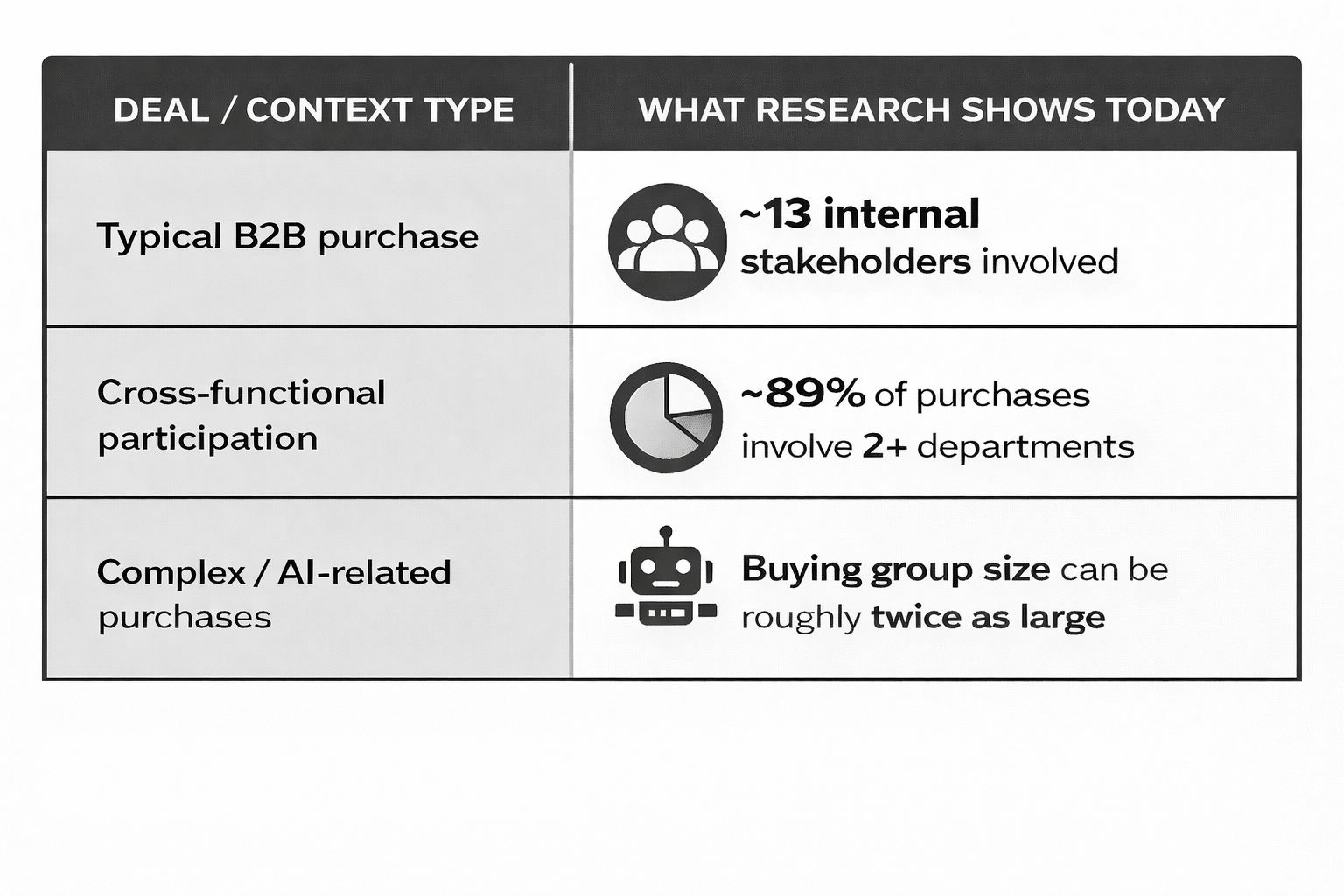
This isn’t just a “feels like more people” situation. Forrester’s State of Business Buying, 2024 report finds that an average of 13 people within an organization are involved in a buying decision, and that 89% of purchases involve two or more departments. In the 2026 follow‑up, based on nearly 18,000 global business buyers, Forrester reports that 13 internal stakeholders and 9 external participants influence the typical B2B purchase, with buying groups getting even larger as the deal becomes more complex or expensive.[Forrester]
It gets even more intense when emerging tech is involved. Forrester notes that when a purchase includes generative AI features, the size of the buying group effectively doubles compared to non‑AI purchases (14 people versus 7). In other words, the more strategic and sensitive the solution, the more people crowd into the decision.
So if it feels like there are more people on the call than at your cousin’s wedding, you’re not exaggerating, that’s simply how modern B2B decisions are made now, with double‑digit numbers of stakeholders all wanting a say.[Forrester]
You can think of it roughly like this:
McKinsey’s B2B growth research also points out that buying journeys are increasingly non‑linear and multi‑stakeholder, reinforcing that it’s no longer realistic to treat “the buyer” as a single person.[mckinsey]
Common roles in a buying committee
Once you’ve seen a few, you realize: different logos, same characters, mostly.
Most buying committees share a recognizable set of roles, even if titles differ by company.
- Initiators / project sponsors – Spot the problem or opportunity and kick off the internal conversation about evaluating solutions. This is the person who says, “We can’t keep doing this in spreadsheets,” and everyone else pretends they just noticed.
- End users – People who will use the product daily and care about usability and workflow impact. They’re thinking, “Is this going to make my life easier, or am I about to become unpaid QA?”
- Influencers – Colleagues or specialists who shape opinions, compare options, and recommend a shortlist. You don’t always see them on calls, but their “I’m not convinced” in a side chat can kill your deal in 10 seconds.
- Technical evaluators / IT / security – Assess integration, architecture, performance, and security/compliance fit. These are the people who hear “simple API” and immediately open a 47‑item checklist.
- Decision-makers / executive sponsors – Senior leaders with formal authority who ensure strategic alignment and give final approval. They might not read your deck, but they’ll absolutely judge your slide with the ROI number.
- Budget holders / financial approvers – Finance leaders who validate cost, ROI, and budget availability before sign-off. They see your platform, your services, your beautiful roadmap, and then they boil it down to one line: “Annual subscription, how much?”
- Legal, risk, and procurement – Manage contracts, compliance, vendor risk, and the purchasing process. They don’t care about your features. They care about clauses, caps, and who sues who when it all goes sideways.
- Gatekeepers – Control access to senior decision-makers and filter vendor communication. If you’re not on their calendar, you’re not in the deal. Simple as that.
These are the people inside your “one account.” You’re not navigating an org chart; you’re navigating a family dinner with politics, history, and that one person who always says, “That’s not how we do things here.”
Why buying committees exist
Now, before we roast them too hard, buying committees do exist for a reason and are very valuable.
Buying committees are a response to the complexity, cost, and risk of modern B2B purchases. Major purchases affect multiple departments, tech stacks, and workflows, so companies bring in cross‑functional stakeholders to avoid downstream issues. Shared decision-making helps reduce individual risk, spread accountability, and ensure regulatory, security, and financial requirements are met. As digital transformation and oversight functions (security, data, AI governance) expand, more roles get a say, which naturally increases committee size over time.
In other words: once upon a time, one VP could say “Let’s buy it,” and that was it. Today, if one person did that, they’d be in front of three different committees explaining themselves by Friday.
What this means for sales and marketing
Here’s the punchline for revenue teams: your “buyer” is the whole committee, not just your primary contact.
For revenue teams, the practical implication is that your “buyer” is the whole committee, not just your primary contact. You need to identify all key stakeholders, understand what each cares about, and “multi‑thread” relationships across departments. Content, messaging, and enablement must speak to different lenses: strategic outcomes for executives, ROI and risk for finance, feasibility for IT, and day‑to‑day value for users. Deals slow or stall if even one critical role (like security, finance, legal) is ignored, which is why mapping and engaging the full buying committee has become a core B2B go‑to‑market discipline.
So when your champion says, “Everyone’s on board,” don’t just trust, verify. Ask: “Who else needs to feel good about this?” “Who could block it?” “Who signs?” Then build a path for each of them.
You’re not just closing a deal. You’re directing a cast of smart, capable humans, each with their own priorities, incentives, and a quiet hope that nothing explodes on their watch.
The real shift happens when you stop pretending there’s one buyer and start selling like you’re in a room full of thoughtful skeptics. Not hostile. Not difficult. Just responsible.
Each person needs a slightly different reason to feel confident enough to nod… and eventually say “yes.”

